
In today’s digital world, content plays a huge role in online success. Businesses, bloggers, and digital marketers all depend on content to attract visitors, build trust, and generate leads. But simply publishing content is not enough. To appear on the first page of Google, you must focus on creating high quality content that provides value to readers and meets search engine standards.
Search engines like Google constantly update their algorithms to prioritize useful, relevant, and trustworthy information. This means that websites with high quality content have a better chance of ranking higher in search results.
In this blog, we will explore practical strategies that help you create high quality content that ranks on Google and drives long-term organic traffic.
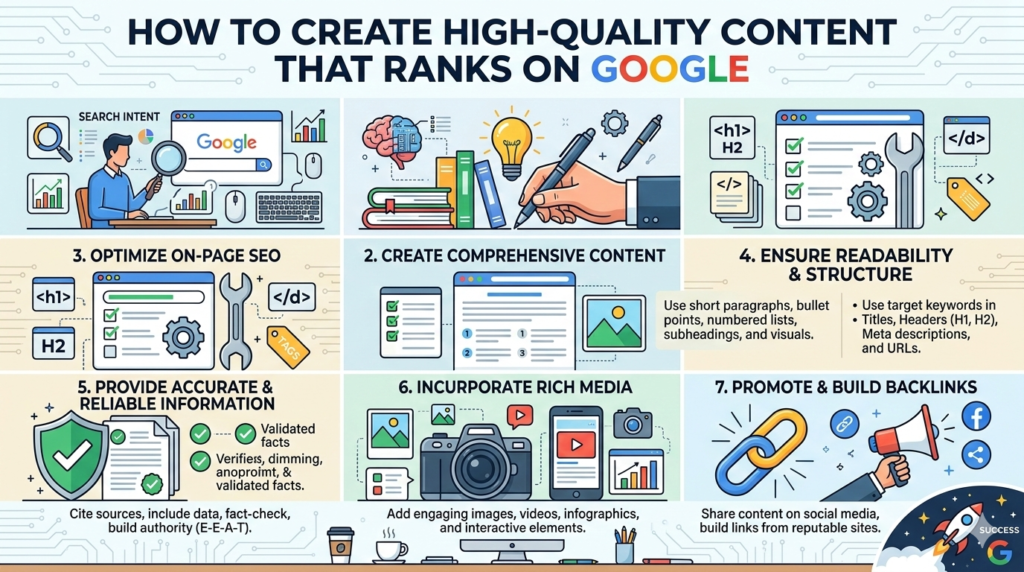
Understanding What High Quality Content Means
Before learning how to create it, you need to understand what high quality content actually means.
High quality content is content that:
- Provides accurate and useful information
- Solves the reader’s problem or answers their question
- Is easy to read and well structured
- Uses reliable sources and facts
- Is optimized for search engines without overstuffing keywords
Google’s main goal is to deliver the best possible answers to users. Therefore, if your content genuinely helps readers, Google will naturally reward it with better rankings.
Start with Proper Keyword Research
Keyword research is the foundation of SEO content. It helps you understand what people are searching for and how you can create high quality content around those topics.
When choosing keywords, focus on:
- Search intent – What users want to learn or solve
- Search volume – How many people search for that keyword
- Competition level – How difficult it is to rank
Tools like Google Keyword Planner, Ubersuggest, and Ahrefs can help identify keywords related to your topic.
Instead of targeting only one keyword, include related keywords and variations naturally within your content. This helps search engines understand your topic better and increases the chances of ranking.
Focus on User Intent
One of the biggest ranking factors today is search intent. Google wants to show results that match what the user is looking for.
There are four main types of search intent:
- Informational – Users want to learn something
- Navigational – Users want to find a specific website
- Transactional – Users want to buy a product or service
- Commercial investigation – Users compare options before purchasing
To create high quality content, your article must match the user’s intent. For example, if someone searches “how to create high quality content,” they expect a detailed guide, not a short paragraph.
Understanding intent ensures your content provides exactly what the reader is looking for.
Write Clear and Engaging Headlines
Your headline is the first thing readers see. If it’s not attractive or clear, people will not click on your article.
A good headline should:
- Include the main keyword
- Clearly explain the topic
- Spark curiosity or promise value
Examples of effective headlines include:
- “10 Proven Ways to Create High Quality Content for SEO”
- “A Complete Guide to Writing High Quality Content That Ranks”
Strong headlines increase click-through rates and help your content perform better in search results.
Structure Your Content Properly
Well-structured content improves both readability and SEO. Readers prefer articles that are easy to scan and understand.
Here are some formatting tips for high quality content:
- Use clear headings and subheadings (H2, H3)
- Write short paragraphs
- Use bullet points and numbered lists
- Highlight important information
- Maintain logical flow between sections
A good structure helps readers quickly find the information they need and keeps them engaged with your content.
Create Valuable and Original Information
Google values originality and depth. Simply rewriting existing articles will not help your content rank.
Instead, aim to provide:
- Unique insights
- Practical examples
- Real experiences
- Updated data and statistics
The more helpful your article is, the more likely readers will stay on your page and share it with others. This increases engagement signals that help your high quality content rank higher.
Optimize Content for SEO
SEO optimization ensures that search engines understand your content and index it correctly.
Important SEO practices include:
Use the Keyword Naturally
Include your main keyword high quality content in important places such as:
- Title
- Introduction
- Subheadings
- Meta description
- Throughout the article naturally
Avoid keyword stuffing because it can harm your rankings.
Use Internal Links
Linking to other pages on your website improves navigation and helps search engines crawl your site.
For example, if you have blogs about SEO strategies, content marketing, or keyword research, link them within your article.
Add External Links
Linking to trustworthy sources increases credibility and shows Google that your content is well researched.
Improve Content Readability
Even the most informative article will fail if it is difficult to read.
To improve readability:
- Use simple language
- Avoid complicated sentences
- Break long paragraphs into smaller ones
- Use conversational tone
High readability keeps visitors on your page longer, which is an important signal for search engines.
Use Visual Content
Visual elements make content more engaging and easier to understand.
Examples include:
- Images
- Infographics
- Charts
- Videos
- Screenshots
Visuals not only improve user experience but also increase the chances of your content being shared on social media.
Make sure to add alt text to images so search engines can understand them.
Keep Your Content Updated
Search engines prefer fresh and updated information. Outdated articles may lose rankings over time.
To maintain high quality content, regularly:
- Update statistics and data
- Add new insights
- Improve outdated sections
- Refresh keywords if needed
- Updating content signals Google that your website provides relevant and current information.
Focus on E-E-A-T Principles
Google uses the concept of Experience, Expertise, Authoritativeness, and Trustworthiness (E-E-A-T) to evaluate content quality.
You can improve E-E-A-T by:
- Sharing real experience and knowledge
- Adding author information
- Using credible sources
- Providing accurate and reliable content
Websites that demonstrate strong expertise and trustworthiness are more likely to rank higher.
Encourage User Engagement
User engagement plays a significant role in SEO rankings. When readers interact with your content, it signals that the article is valuable.
Ways to increase engagement include:
- Asking questions within the article
- Encouraging comments
- Adding share buttons
- Creating interactive content
The more users engage with your high quality content, the more Google recognizes its value.
Promote Your Content
Publishing content is only the first step. Promotion helps bring more traffic and visibility to your blog.
You can promote your article through:
- Social media platforms
- Email newsletters
- Online communities and forums
- Guest blogging
- Content partnerships
When more people discover and share your content, it increases its authority and ranking potential.
Measure Content Performance
Tracking performance helps you understand whether your content strategy is working.
Use tools like Google Analytics and Google Search Console to monitor:
- Organic traffic
- Keyword rankings
- Bounce rate
- Time on page
- Click-through rate
Analyzing this data helps you improve future high quality content and optimize existing articles.
Common Mistakes to Avoid
Even experienced marketers sometimes make mistakes that affect their rankings.
Avoid these common issues:
- Keyword stuffing
- Writing content only for search engines
- Publishing very short articles
- Ignoring mobile optimization
- Using misleading headlines
Your main focus should always be creating valuable content for real readers.
Final Thoughts
Creating high quality content that ranks on Google requires a combination of strategy, creativity, and consistency. It is not just about inserting keywords but about delivering real value to your audience.
When you focus on understanding user intent, providing useful information, optimizing for SEO, and maintaining good readability, your content has a much better chance of ranking higher in search results.
Remember that SEO is a long-term process. Consistently publishing high quality content will gradually build your website’s authority, attract organic traffic, and help you achieve sustainable growth online.
By applying the strategies discussed in this guide, you can start creating content that not only ranks on Google but also truly helps your audience. If you want implement these trend on your business, approach the best digital marketing freelancer in Kasaragod